In contemporary interior architectural design, wall materials serve far more than basic decorative purposes. They act as core elements that define spatial texture, acoustic conditions, structural stability and final build outcomes. Conventional latex paint, sintered stone slabs and solid wood flat panels carry notable limitations: many offer generic aesthetics with limited design variety, while others possess heavy mass that restricts applicable scenarios and comes with steep long-term maintenance costs.
Solid wood mosaics have gained widespread favor among architects and interior designers because they integrate natural aesthetics, practical functionality, construction flexibility and long-term dimensional stability, satisfying requirements for luxury private residences, commercial public projects and artistic venues alike.
Most observers only focus on visual appeal, yet professional designers evaluate overall performance when selecting materials. Natural timber delivers inherent humidity regulation and sound absorption; three-dimensional profiles generate rich light and shadow dynamics; modular units simplify on-site installation; and standardized moisture content control ensures lasting reliability. Below we analyze the core competitive strengths of solid wood mosaics through three flagship styles proven for construction projects.
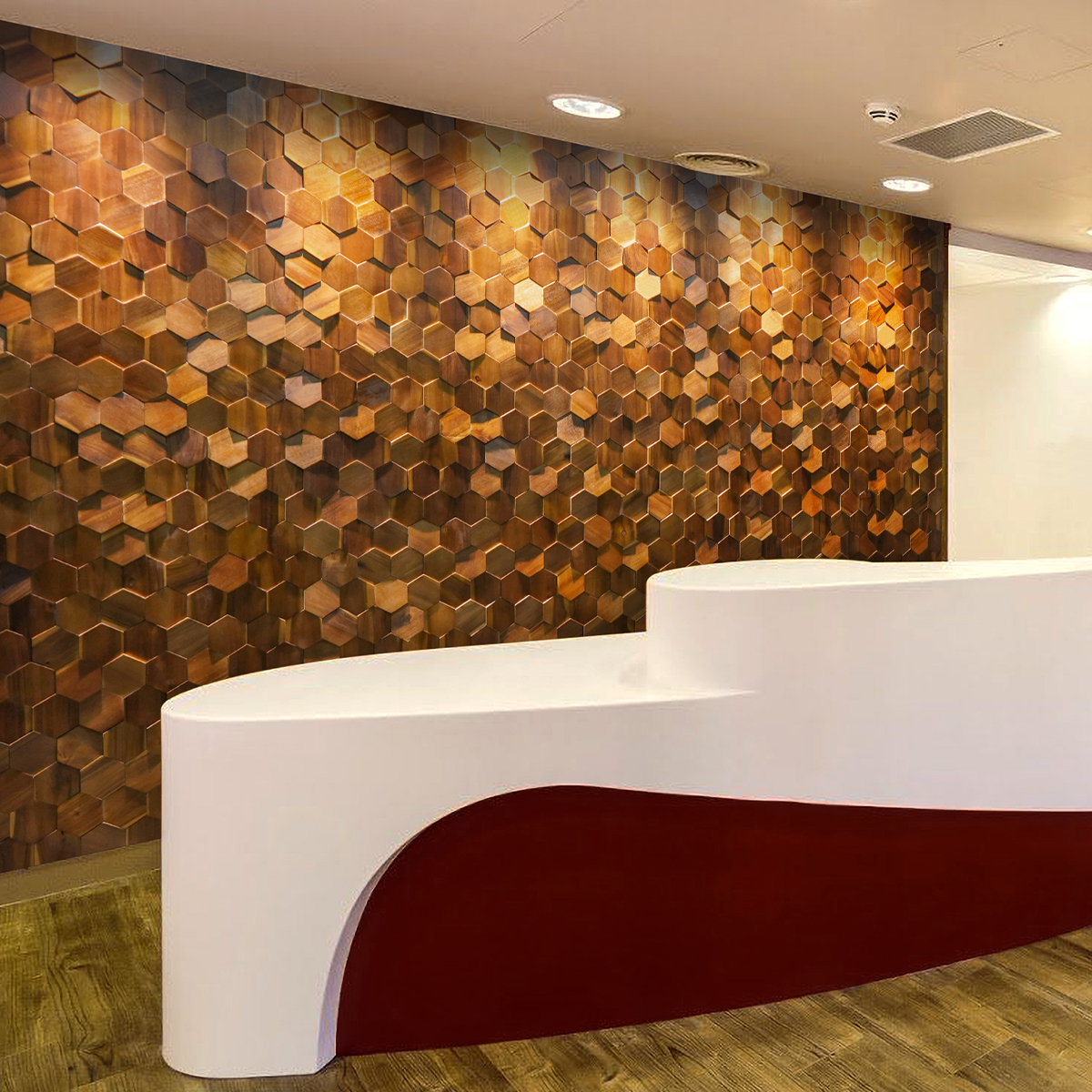
Southeast Asian Walnut Hexagonal 3D Solid Wood Mosaic Accent Wall | Modular Design, Ideal for Both Commercial 、 Residential Projects
From an architectural perspective, orderly geometric modular systems represent a proven solution for large-area installations with reliable performance and lower execution risks. Southeast Asian walnut features consistent density and stable structure. Finished panels are manufactured within the optimal moisture content range, minimizing cracking, warping and joint shrinkage triggered by seasonal temperature and humidity fluctuations across northern and southern climates, preserving uniform appearance over decades.
The hexagonal 3D splicing delivers excellent symmetry and evenly spaced seams. Three-dimensional textures eliminate the flat monotony of plain walls with restrained, uncluttered forms. Its undulating surface delivers natural acoustic conditioning, diffusing sound waves and reducing echoes to refine indoor sound fields. Widely specified for hotel lobbies, premium office spaces, private clubs and living rooms in large open-concept homes. Standardized modules streamline installation with generous construction tolerance, making it a dependable material choice for designers managing large-scale developments.
Rubber Wood Triangular Pyramid 3D Solid Wood Mosaic Accent Wall | Outstanding Light 、 Shadow Performance to Establish Spatial Focal Points
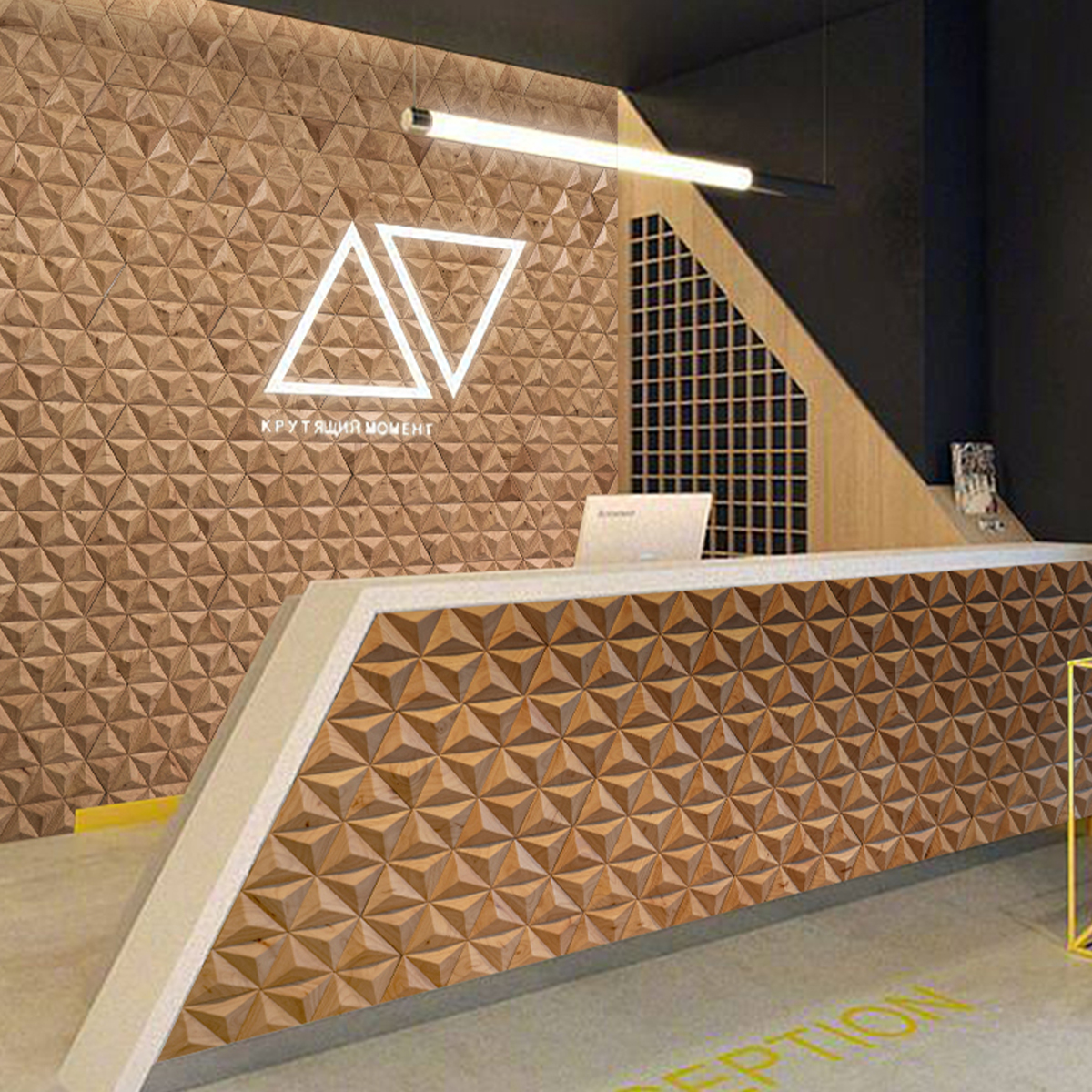
Contemporary design embraces contrasting aesthetics: minimalist negative space balanced with dimensional depth. This rubber wood triangular pyramid mosaic aligns perfectly with this design trend. Rubber wood offers strong cost performance, reliable eco-friendly properties and superior abrasion resistance, suited for permanently enclosed indoor environments in both residential and commercial settings.
The distinctive multi-faceted triangular pyramid form reflects light across numerous angles, creating immersive layered lighting effects under recessed lighting schemes. Its dimensional expressiveness surpasses flat panels and conventional curved finishes, instantly forming powerful visual anchors and resolving the common design challenge of empty expansive white walls that lack depth despite abundant soft furnishings. Suitable for brand exhibition halls, live streaming studios, creative commercial venues and light-luxury residences, enabling designers to craft unique artistic character.
Cumaru Small Concave Arc 3D Solid Wood Mosaic Accent Wall | Gentle Silhouettes for Calm, Textured Interiors
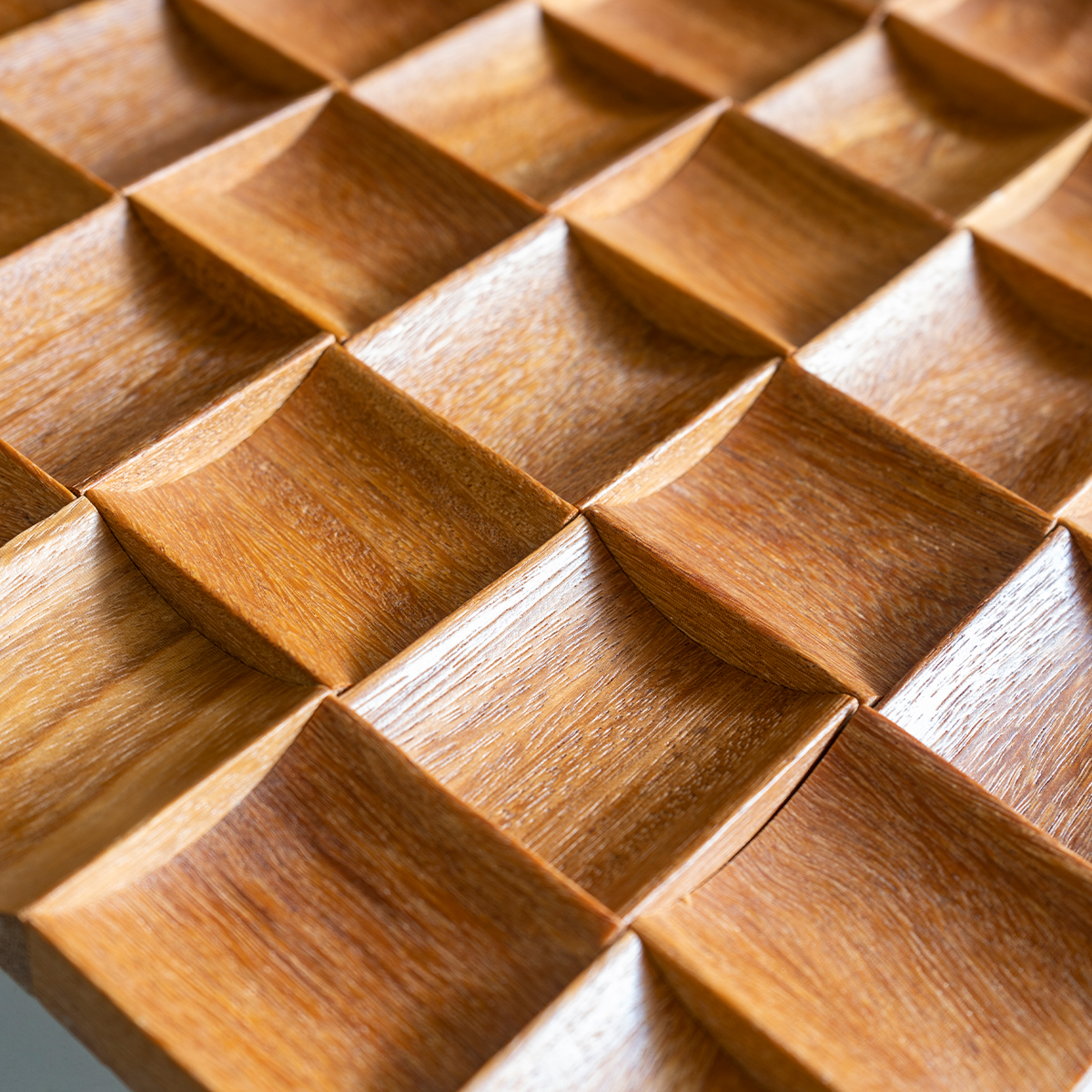
For projects pursuing soothing atmospheres such as Neo-Chinese, Zen and quiet light-luxury schemes, designers favor wood finishes with soft lines free of sharp edges. Cumaru boasts highly distinctive natural grain, warm rich tones and dense durable timber, balancing striking visual character with robust structural performance.
Small concave curved three-dimensional forms soften the stark coldness of hard construction materials, with gradual light transitions that embody the relaxed texture valued in modern design. Fine curved surfaces assist gentle sound absorption. Combined with the timber’s humidity regulating properties, it cultivates peaceful, comfortable environments ideal for tea rooms, master bedrooms, studies and high-end wellness spaces. The understated, timeless aesthetic continuously elevates the cultural depth of interiors.
Four Key Reasons Architects Favor Solid Wood Mosaics
Distinctive Aesthetic Value: One-of-a-kind natural timber grain paired with layered dimensional light and shadow avoids generic interior design outcomes, compatible with all mainstream design styles.
Superior Multifunctional Performance: Natural substrate provides built-in sound absorption and humidity control, improving indoor acoustics and microclimate, outperforming rigid finishes such as tile and sintered stone.
High Site Adaptability: Modular units fit walls of varying sizes and ceiling heights. Two installation methods — adhesive bonding and mechanical fixing — deliver flexible construction with greater tolerance for on-site adjustments.
Long-Term Stability: Standardized moisture management reduces deformation, peeling and cracking caused by humidity shifts, maintaining intact finish appearance and cutting ongoing maintenance expenses.
Exceptional high-end design does not rely on stacking costly materials. It hinges on selecting core finishes that unite aesthetics, functionality and practicality. These three differentiated solid wood mosaic lines fully cover commercial public construction and luxury residential requirements, aligning with the evolution of modern interior design — the fundamental reason they continue to earn recognition from architects.